Arne Saknussemm’s dagger
A Journey to the Centre of the EarthArne Saknussemm’s dagger is the crucial physical clue that turns the explorers’ suspicion of a predecessor into evidence. Found half buried in sand on a shore they believe they have reached before, the rusty weapon is recognized as a sixteenth-century Spanish dagger, not an ancient implement. Its steel blade bears marks left by someone trying to inscribe the nearby rock; the initials A. S. on a smoothed granite tablet then connect the object to Arne Saknussemm and his passage through the underground world.
Discovery on the shore
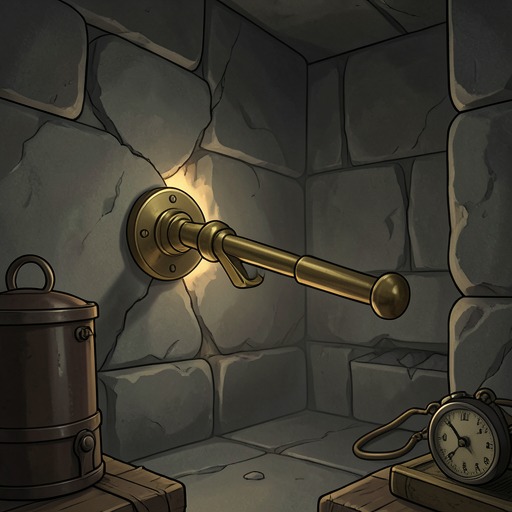
After the Central Sea storm has driven the explorers back toward a familiar-looking coast, Harry examines the shore for signs that they have been there before. Professor Hardwigg doubts the identification: the rocks look alike, and there are no traces of their own footsteps. Harry spots something shining in the sand, rushes forward, and picks up a rusty dagger of singular shape. The object is not one he recognizes as his own, and Professor Hardwigg initially suggests it may have belonged to Hans, who might have dropped it.
Harry rejects that explanation. He knows Hans’s habits and is certain the weapon was never his. Its discovery thus does more than furnish the party with another artifact: it challenges the assumption that the travelers are alone in this place and gives material form to the possibility that someone came before them.
Dating and identifying the weapon
The dagger’s appearance produces competing interpretations. Harry wonders whether it might have belonged to an antediluvian warrior, but observes that it is not a weapon of the Stone Age or Bronze Age: it is made of excellent steel. Professor Hardwigg reins in that speculation. He identifies it as a Spanish dague of the sixteenth century, the kind of weapon gentlemen wore at their belts to deliver a final blow to an enemy who would not surrender. It belongs to none of the explorers or other living beings they know to be in the earth’s interior.
The rust suggests a long abandonment. Professor Hardwigg points out that the blade’s regular coating of iron mold is far older than a day, a year, or even a century. He then notices a second, more consequential feature: the jagged edges were not produced by resistance from human blood and bone. In his account, someone has indented the blade while trying to carve an inscription into the rocks. The weapon is therefore both an object left behind and a record of an earlier act of writing.
From artifact to inscription
The dagger changes the party’s reading of the landscape. Harry reasons that it could not have reached the shore by itself: someone must have preceded them. Professor Hardwigg agrees that the evidence points to a man, and the explorers set out along the rock wall, scrutinizing even its smallest fissures for a passage onward.
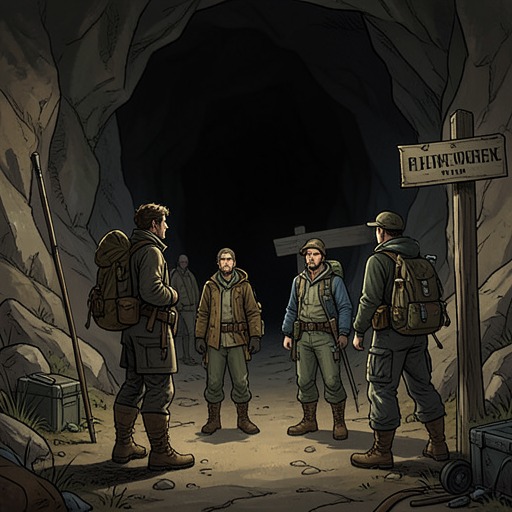
They reach a stretch of shore scarcely more than two yards wide, hemmed in by steep, lofty rock with the sea almost washing its foot. Beneath a huge overhanging rock, they find the entrance to a dark tunnel. Nearby, on a square granite tablet smoothed by rubbing it with another stone, two much-worn initials are visible: A. S. Professor Hardwigg reads them as the initials of Arne Saknussemm, confirming that the earlier traveler whose presence the dagger implied had left a mark at the tunnel entrance.
Material evidence and the expedition’s history
The dagger’s force lies in the sequence of inferences it makes possible. Its steel construction rules out the prehistoric origins Harry briefly entertains; its Spanish workmanship and sixteenth-century form establish a historical date; its extraordinary rust indicates prolonged exposure; and the marks on its edge connect it to the attempt to carve the rock. The initials at the tunnel then supply the identity that the weapon alone cannot establish. A mysterious object becomes part of a legible chain of evidence.
That chain also gives the explorers a concrete basis for continuing their search. Earlier, Professor Hardwigg had treated differences between the handwriting in a manuscript book and a smaller parchment document as evidence that the latter was written centuries later, reasoning from the addition of a double M to Icelandic in the twelfth century. In the underground journey, the evidence is no longer only textual or linguistic: a battered blade, a carved tablet, and a tunnel entrance locate Saknussemm’s passage in the physical world. The dagger matters not as a useful weapon but as a trace of human action, making the vanished traveler’s route visible at the moment the explorers need proof that it exists.